During the first autumn at our new country home, on 3.5-acres in west-central Illinois, I blazed a trail through the woods along a borderline ravine. The Ravine Trail gives me access to a part of the land seldom if ever visited by the previous owners. The wooded ravine is the type of forgotten, unmanaged landscape that has always drawn my attention.
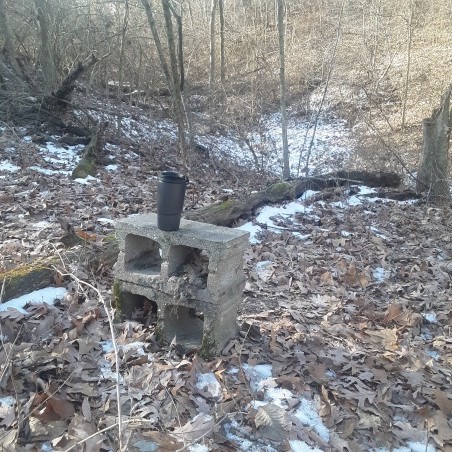
Near the furthest point along the trail, I set one cinder block on top of another. A bench, of sorts. A place for sitting in solitude, hidden, unobserved; here I can see the woods continuing gradually downslope toward Killjordan Creek. This spot has become my “listening point” in the tradition of the naturalist Sigurd F. Olsen. In his book Listening Point (first published in 1958), Olsen wrote that “Everyone has a listening-point somewhere. It does not have to be…close to the wilderness, but some place of quiet where the universe can be contemplated with awe.” Listening point is a self-defining term; you’ll recognize the place when you’re there.
Only four months in our new home, I am still learning how to live in these unfamiliar surroundings, trying to maintain cherished routines from our four and a half years residing within the town of Macomb. One of those routines is having the first cup of morning coffee in the backyard. A travel mug helps keep the coffee warm as I negotiate the new trail’s roughness and sideways slant; but I know as the years go by, natural wear will even it out, and where I place my feet may not require so much attention.
It may take a few years before I am intimately familiar with every tree, shrub, and wildflower in view from the cinderblock bench. The standing dead trees are especially important with their woodpecker holes and insects hidden within loose bark and rotting wood; all of these snags will eventually fall and be replaced by other trees that have succumbed to disease, wind damage, or competition for the limited resources of light, nutrients, and water. Numerous logs lying on the forest floor attest to this dynamic. From woody debris to humus and soil, feeding the substrate for the next generation of plants.
One morning I sat on the cinderblocks watching the occasional blue jay, white-breasted nuthatch, and downy woodpecker flying along the ravine to and from birdfeeders located near the house. I also heard calls of American goldfinches and house finches from the same direction. The feeders drew birds from far away, and I wondered if any of our several distant neighbors fed them or if I was the only one. And then I heard a train whistle from the track about a mile and a half to the north; a not unpleasant sound I used to enjoy hearing when in town, when we lived half the distance from the same track. I would imagine a train leaving town and then traveling through the rolling farmlands, hills, and hollows—over the same type of surroundings where I now lived. It’s still a welcoming sound, even at the listening point where my focus is on the natural world, because the sound has a deeper meaning and is linked to how I arrived at this station in life.
Forty years before, on a warm summer morning, I had discovered my first listening point at Spear Woods Forest Preserve near Chicago. I used to follow a deer path from the main hiking trail to avoid the many noisy visitors who also loved the woods. Their loud talking detracted from my experience. But the thickness of the forest eventually muffled sounds, and I imagined being surrounded by true wilderness. Further along, there was a shallow open-water area fringed with wetland plants: Hogwash Slough, I later learned. I suspected it was a pothole depression created around ten thousand years before, after a massive block of glacial ice melted. In one area, a tree had fallen in such a way that its trunk resembled a bench facing the slough. I took a seat and stayed a while. The water attracted an abundance of bird life; and as I was just beginning to study birds, it was a place of many firsts, making lasting impressions that are still vivid after so many years: great egret, belted kingfisher, yellow-crowned night heron, osprey, and more. One winter its surface had frozen. The temptation was too much. I shuffled across the ice, plunged through, and stood in water two feet deep.
I returned to Hogwash Slough as often as possible. It was the first stop on a longer hike that included remnant prairies and oak woodlands. The final stop was at an old white oak tree where I sat, read books, and napped. Occasionally on cold mornings, the dense air carried sounds more efficiently, and I heard a distant rumbling train along the Des Plaines River corridor. In my late twenties, I had not yet found my calling in life until one day, after visiting the slough, the answer became as clear as anything had ever been to me; it had been, in fact, all around me the whole time. But I was unsure where I would study field ecology, what kind of employment I might pursue, or where it would take me. The young single man with full health, no ties, few responsibilities, and a light baggage claim. What a golden time that was. But the best days are the present, and with a nostalgic look backward, I see my former career in natural resources and these current days of retirement as being bookended between the listening points at Hogwash Slough and the cinderblock bench.
* * *
Even though I experienced each of those many days at Spear Woods as a necessary escape from my urban life, I always had to return to reality, which made the woodland hikes seem as an alternate reality. These days, I am of one reality; where I am is where I want to be, though I sometimes miss the old wanderlust. The train whistle still is a welcome sound. I listen for it as a reminder of the histories, inventions, and developments that had to occur so a society could exist where a man could choose to sit in peace on a couple of cinderblocks in the woods and listen for bird songs. That so many people the world over—embroiled as they are in wars, oppression, and poverty—do not have and may never be able to conceive of such a luxury is not far from the center of my thoughts.
Sigurd F. Olsen recognized this too, most particularly near the end of a wilderness canoe trip; in Listening Point, from a chapter entitled “The Whistle,” he wrote the following: “Without that long lonesome wail and the culture that had produced it, many things would not be mine…I must never again forget that because of the wonders it [civilization] had wrought this richness now was mine.” Whether narrowly focused on some aesthetic or scientific aspect of nature or broadly concerned about environmental issues, it’s easy to lose track of such an important insight.
[This essay originally appeared in Illinois Audubon magazine, Number 372, Fall Issue, 2025.]
 Thomas V. Lerczak
Leave a comment